
Payment Fraud Analytics: How to Stop Fraud Without Blocking Good Customers

Key Takeaways
Payment fraud analytics should reduce fraud and false declines, so you stop bad payments without turning away good customers.
Modern programs use layered methods—rules, machine learning, anomaly detection, velocity checks, and behavioral analytics—across the entire payment lifecycle, including cards and ACH.
A practical implementation framework and clear KPIs help you treat fraud analytics as a revenue optimization engine, not just a cost center.
Payment fraud analytics: how to stop fraud without blocking good customers
Fraud is an obvious threat to revenue—when bad transactions slip through, you absorb direct losses, chargebacks, investigation costs, and downstream damage to customer trust. But there’s another side to the fraud equation that’s just as costly: good payments that get blocked by overzealous controls. False declines depress approval rates, frustrate customers, and quietly push them to competitors.
The promise of payment fraud analytics is precision. Instead of simply “saying no” more often, you use data science, machine learning, and behavioral tracking to distinguish risky activity from legitimate behavior in real time. Done well, payment fraud analytics reduces fraud and reduces unnecessary friction, so you can safely approve more good payments.
This guide explains what payment fraud analytics is, the types of fraud it can detect (including ACH and account‑to‑account scams), the core analytical methods behind modern decisioning, and a practical framework to implement it in your business.
The business case: what payment fraud is actually costing you
The direct cost of payment fraud is only the starting point. When a fraudulent transaction gets through, you face chargebacks, network and processor fees, write‑offs, manual review workloads, and the labor required to investigate and respond. Those costs compound over time, especially for organizations with high transaction volumes or thin margins.
Fraud incidents also erode trust. Customers who experience unauthorized charges or repeated disputes often blame the brand that processed the payment, not just the bad actor behind it. That reputational damage can lead to higher churn and lower lifetime value.
On the other side of the ledger, false declines quietly drain revenue. Overly strict rules, blunt filters, or poorly tuned models block legitimate customers, reduce authorization rates, and create extra support tickets as people try to resolve declines. A customer who has to call their bank or your contact center just to complete a purchase may not come back.
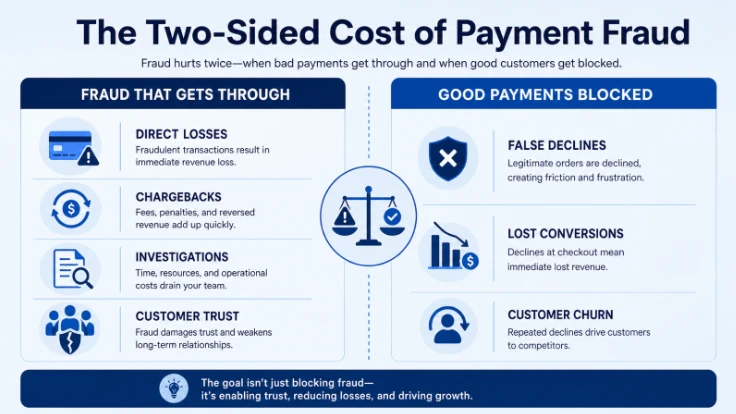
Effective payment fraud analytics addresses both sides: it reduces successful fraud attempts while preserving (and ideally improving) legitimate approval rates.
Types of payment fraud that analytics can detect
Payment fraud analytics monitors transaction data, identity and device signals, behavioral patterns, and post‑transaction outcomes to uncover a wide range of threats. Common fraud types include:
Fraud type | What it looks like |
Card‑not‑present (CNP) fraud | Stolen payment credentials are used in ecommerce, mobile, or other remote transactions where the physical card is not presented. |
New‑account fraud | A bad actor creates an account with stolen, synthetic, or manipulated identity information and uses it to transact. |
Identity & synthetic identity fraud | Criminals misuse real or fabricated identity elements to pass onboarding or account checks. |
Account takeover (ATO) | An attacker gains control of a legitimate account and uses valid credentials to make payments or change account details. |
Chargeback & friendly fraud | A cardholder disputes a legitimate transaction or abuses refund and dispute policies. |
ACH fraud | A criminal redirects payroll, vendor, or other ACH payments by changing account or payee details. |
Authorized push payment (APP) fraud | A victim is manipulated into authorizing a payment to a fraudster, often through impersonation or social engineering. |
Card testing & enumeration | Bots test stolen card data with small or repeated transactions before larger fraud attempts. |
ACH and other account‑to‑account fraud deserve extra attention. Because these payments use bank account and routing information instead of card numbers, analytics should be tuned to flag account‑name mismatches, unusual changes to payee details, and velocity anomalies in payroll or vendor‑payment patterns. Robust ACH payment fraud analytics helps catch problems before funds leave the account.
Core analytical methods: how payment fraud analytics works
Older fraud programs often hinge on static rules—if transaction amount > X and country = Y, decline. Rules still matter, but on their own they can’t keep pace with evolving fraud tactics or nuanced customer behavior.
Modern payment fraud analytics layers multiple methods that can score risk in milliseconds, combining historical patterns with real‑time signals to produce a decision such as approve, step‑up authentication, decline, or manual review.
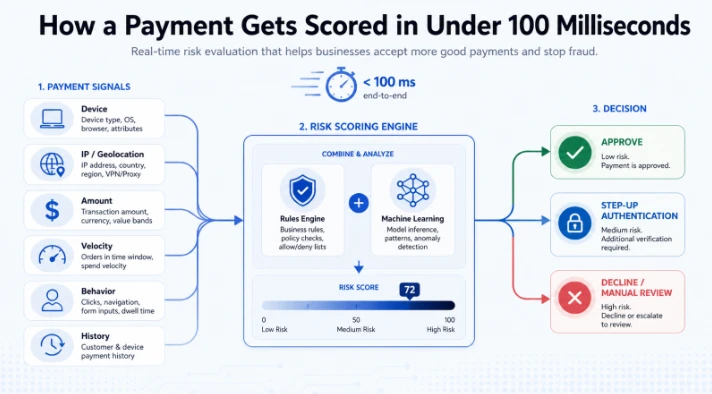
In the broader analytics spectrum, fraud teams may talk about descriptive (what happened), diagnostic (why it happened), predictive (what’s likely next), and prescriptive analytics (what to do). In day‑to‑day operations, four techniques do much of the work.
Anomaly detection
Anomaly detection flags deviations from an established baseline—such as a sudden high‑value purchase, a new location, or out‑of‑pattern time‑of‑day behavior for a specific customer or merchant. Machine learning models continuously refine what “normal” looks like for each user or entity, which makes alerts more precise over time. For example, if an account that usually pays small domestic invoices suddenly initiates a large international transfer, anomaly detection can increase the risk score and trigger extra checks.
Velocity checks
Velocity checks monitor how often and how quickly transactions occur from a card, device, IP address, account, or payee within a short window. They’re especially useful against bot‑driven attacks like card testing, credential stuffing, and rapid sequences of account or beneficiary changes. Examples include card‑velocity limits (transactions per card per hour), IP‑velocity thresholds, device‑ID velocity, and account‑velocity rules for payee edits or payout bursts.
Behavioral analytics for real‑time payment fraud prevention
Behavioral analytics for real‑time payment fraud prevention examines typing cadence, mouse movement, navigation paths, form‑filling behavior, and device fingerprints to build a behavioral signature. Because behavioral biometrics focus on how someone interacts rather than just what credentials they use, they can help surface account takeover even when attackers have valid usernames, passwords, and one‑time codes.
Predictive modeling and graph analysis
Predictive modeling uses historical transaction data and outcomes to forecast how likely a new payment is to be fraudulent before it’s completed. Graph analysis maps relationships between accounts, devices, identities, and payments to uncover fraud rings and money‑mule networks that look harmless when examined transaction by transaction.
These techniques are often powered by supervised learning (models trained on labeled fraud vs. non‑fraud), unsupervised learning (to detect new patterns), deep learning, and natural language processing—for example, parsing free‑text fields attached to ACH payments to extract additional risk signals.
Fraud analytics across the payment lifecycle
Fraud risk doesn’t appear at a single moment, and neither should your analytics. A strong program spans pre‑purchase, checkout/authorization, and post‑purchase monitoring.
Lifecycle stage | What analytics should monitor |
Pre‑purchase | Account creation, identity and device signals, bot activity, credential stuffing, and synthetic‑account indicators. |
Checkout / authorization | Transaction amount, payment instrument, device fingerprint, location, velocity, behavioral signals, and network signals for real‑time decisioning. |
Post‑purchase | Refunds, disputes, chargebacks, account behavior, and emerging patterns that support investigation and model feedback. |
Pre‑purchase analytics help you spot risky sign‑ups and login attempts before attackers can transact. At checkout, real‑time scoring uses the richest mix of signals to decide whether to approve, step up, or block a payment. Post‑purchase analytics look at disputes, returns, and refund behavior to surface friendly fraud, refund abuse, or slow‑burn schemes—and to feed fresh data back into your models.
The false‑positive problem: why precision matters as much as protection
Fraud leaders live with a constant tension: tighten controls to stop more fraud and you inevitably block more good customers; loosen controls to improve approvals and you invite more fraud losses. Payment fraud analytics is how you escape that binary.
Precision, not blunt strictness, is the goal. Accurate scoring lets you automate more low‑risk approvals while focusing friction where it’s justified. This is where payment fraud protection analytics becomes a growth driver as well as a risk tool.
Adaptive or dynamic friction is the practical expression of that idea. Low‑risk transactions sail through with minimal friction, while medium‑ and high‑risk payments trigger step‑up authentication, additional verification, or manual review. Customers experience smoother journeys overall, while your team keeps a tighter grip on genuinely suspicious activity.
(The source outline suggests using a specific dollar estimate for the cost of false declines and an example of strong authentication increasing approval rates. Those specific statistics should be sourced and verified before you add them to this section.)
How to implement payment fraud analytics in your business
Whether you’re modernizing an existing fraud stack or standing up a new program, a simple, repeatable framework will keep your efforts aligned with both risk management and revenue goals. The six steps below apply to ecommerce merchants, financial institutions, billers, and other payment‑intensive organizations, regardless of whether you build, buy, or combine tools.
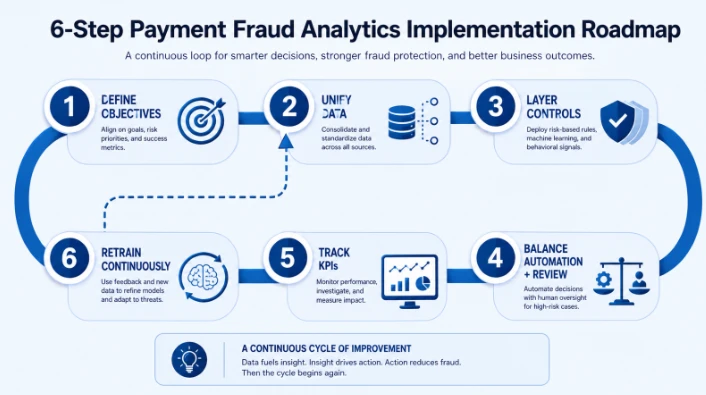
1. Define your objectives
Start by identifying the fraud types most prevalent in your environment—CNP fraud, ATO, chargebacks, ACH redirections, APP scams—and the channels where they appear. Align your analytics program to clear business goals: fraud‑loss limits, chargeback targets, approval‑rate and false‑positive thresholds, customer‑experience expectations, and compliance requirements.
2. Unify your data
Most organizations have a data problem before they have a model problem. To make accurate decisions, your system needs a consolidated view of transaction history, identity records, device fingerprints, behavioral signals, and payment‑network responses. That unified data foundation lets you evaluate entities and context—not just a single transaction in isolation.
3. Build a layered defense
Combine network‑level controls, rate limiting, IP‑reputation checks, authentication controls, multi‑factor authentication (MFA), 3‑D Secure where applicable, real‑time machine‑learning‑based scoring, and post‑authorization monitoring. No single layer is sufficient; layered defenses let you catch more fraud types while avoiding heavy‑handed rules that create unnecessary declines.
4. Balance automation with human review
Use automation for high‑confidence approvals and declines, reserving human analysts for ambiguous, novel, or high‑value cases. Feed the outcomes of manual reviews back into your rules and models so they improve over time—especially around edge cases and emerging attack patterns.
5. Set measurable KPIs
Track a balanced set of metrics: fraud rate, false‑positive rate, chargeback rate, detection rate, approval rate, and mean time to detection. Reviewing fraud and approval metrics together helps ensure you’re protecting revenue on both sides of the ledger instead of driving down fraud at the expense of good customers.
6. Retrain continuously
Fraud tactics evolve quickly. Models and rules that worked last year may be less effective today. Retrain models with fresh transaction outcomes, update rules when you see new attack patterns, and maintain a tight feedback loop between investigations, disputes, and model performance.
When you evaluate build‑versus‑buy options, compare solutions on real‑time scoring latency, support for custom models alongside configurable rules, explainability, data‑quality practices, and transparent false‑positive reporting.
Compliance and governance: what your fraud analytics program must address
Fraud analytics relies on sensitive personal and financial data, so strong governance is non‑negotiable.
At a minimum, any program working with payment cards must align with the Payment Card Industry Data Security Standard (PCI DSS), which sets requirements for securing cardholder data. When you collect or analyze behavioral and device data—such as IP addresses, device IDs, and interaction patterns—you also need to account for privacy regulations like the EU’s General Data Protection Regulation (GDPR) and the California Consumer Privacy Act (CCPA), among others.
If you operate in Europe or process European card transactions, frameworks such as PSD2 and associated 3‑D Secure requirements shape how strong customer authentication is applied and how your fraud‑detection tools interact with bank and network flows. Because requirements and interpretations can vary by jurisdiction, legal and compliance teams should review specific implementations.
Model explainability is another governance pillar. Being able to show why a transaction was flagged or a customer was challenged helps with audits, dispute resolution, and customer communications, and it builds trust with internal stakeholders and regulators.
How CSG Forte fits
Effective payment fraud analytics needs more than clever models. It depends on payment infrastructure that can capture rich signals, exchange data in real time, and orchestrate layered controls without slowing your customers down.
CSG Forte payment solutions are built to support that kind of strategy—connecting payment flows with the data and operational tools organizations use to manage risk and optimize approval rates. By pairing modern analytics with a flexible payments platform, teams can design fraud‑control stacks that protect against evolving threats across cards and ACH while keeping good customers moving.
Learn how CSG Forte can help you design a payment fraud analytics strategy that reduces fraud, cuts false declines, and supports long‑term revenue growth.
FAQs
How do banks detect payment fraud in real time?
Banks typically combine rule‑based filters, machine‑learning models trained on historical data, behavioral analytics, and device intelligence to evaluate each payment as it happens. Transactions are scored against multiple signals, then routed to approval, additional verification, decline, or analyst review based on risk. Layered methods—rather than a single rule engine—help banks adapt as fraud patterns change.
What is the difference between fraud detection and fraud prevention?
Fraud detection and AI-driven fraud detection and financial risk management solutions focus on identifying suspicious or unauthorized activity during or after a transaction, often through analytics, alerts, and case review. Fraud prevention uses proactive controls such as tokenization, MFA, 3‑D Secure, device binding, and account protections to reduce the chance that fraud can occur in the first place. Effective programs combine both approaches, since each catches risks the other can miss.
What KPIs should I track for payment fraud analytics?
Useful KPIs include fraud rate, false‑positive rate, chargeback rate, detection rate, approval rate, and mean time to detection. Evaluating fraud‑rate improvements alongside approval and false‑positive metrics helps you avoid “solving” fraud by declining too many good transactions. Over time, you want lower fraud and lower false positives with stable or improving approval rates.
How does ACH fraud differ from card fraud, and can analytics detect it?
ACH fraud often involves redirecting payroll, vendor, or other bank‑account payments by changing account or payee details, rather than using stolen card numbers. ACH payment fraud analytics should look for account‑name mismatches, unusual payee changes, velocity anomalies, and other pre‑transfer signals that suggest manipulation. Combining these patterns with identity and device data improves the odds of catching ACH fraud before funds are sent.
What should I look for when choosing a payment fraud analytics solution?
Prioritize real‑time scoring, support for custom machine‑learning models and configurable rules, strong explainability, and clear false‑positive reporting. Assess the breadth and governance of the solution’s data sources, as well as integration fit with your existing payment flows and compliance requirements.