
Validate, Validate+, or Authenticate? Understanding ACH Verification Services

Key takeaways
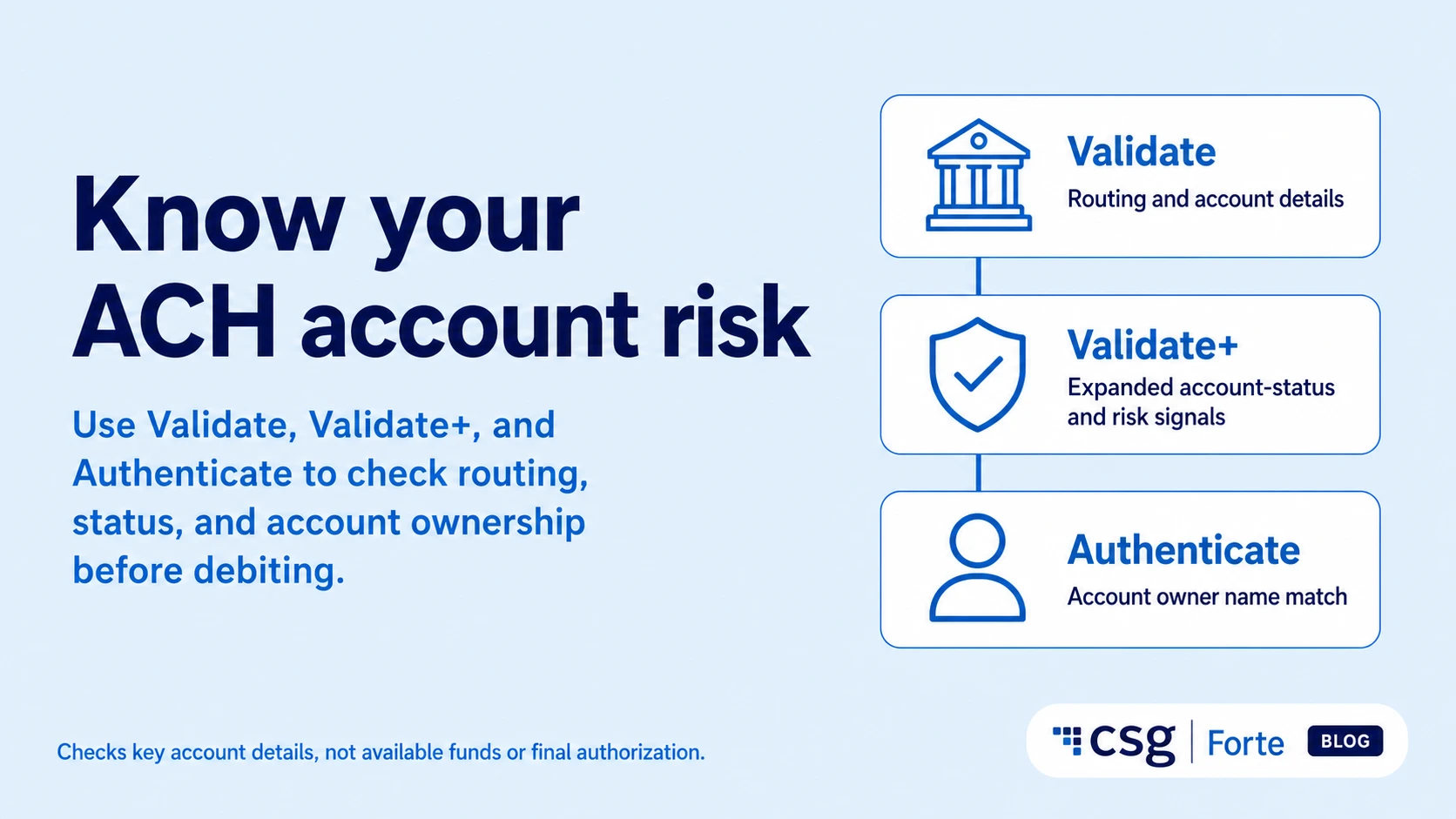
Validate, Validate+, and Authenticate don’t answer the same question:
Validate asks whether the account details appear valid.
Validate+ adds broader account-risk information when available.
Authenticate asks whether the name matches the account owner.
Merchants want to know that an automated clearing house (ACH) payment is going to the right account, that the account doesn’t show obvious risk indicators, and that the person or business submitting the payment is connected to the account owner. Those are related questions, but they’re not the same question.
CSG Forte’s ACH verification services help merchants answer them before submitting a payment. Validate, Validate+, and Authenticate each focus on a different part of the risk picture. The right choice depends on what a merchant needs to confirm.
Learn more about the available capabilities on CSG Forte’s ACH Validation page.
Validate: confirm the account details
Validate is designed for merchants that primarily need to check whether the routing and account information appears valid and can support the intended payment flow. It helps identify incorrect or problematic account details before the transaction is submitted.
That makes Validate a useful first layer for catching common data-entry problems, invalid details, and known account issues. It can help merchants avoid sending payments with information that is unlikely to reach the intended destination.
Validate+: add broader account-risk insight
Validate+ builds on basic account validation by adding broader account-status and risk checks when information is available. Depending on the available data, those checks can include closed accounts, stop-payment indicators, insufficient-funds indicators, and returned-check history.
Validate+ may be a better fit for merchants that want more context before initiating an ACH debit—especially when returned payments create meaningful operational cost, collection work, or customer-service impact.
Authenticate: confirm account ownership
Authenticate addresses a different question: Does the person or business name provided match the owner of the bank account?
This ownership check can help merchants identify mismatches between the customer or business submitting payment information and the account details on file. Authenticate is useful when confirming ownership is an important part of the merchant’s risk strategy.
Authenticate is not a funds check. A successful ownership match does not confirm that money is available, that the debit will be authorized, or that the payment will clear.
Why verification can't prevent every ACH return
Verification is performed before the payment reaches the receiving bank for settlement. Account information, account status, available funds, and customer behavior can change after the check is completed. The receiving bank still makes the final decision when the payment is presented.
For example:
R01 indicates insufficient funds, while R09 indicates uncollected funds. Funds may appear sufficient during verification but be unavailable when the debit reaches the bank.
R07 indicates that authorization was revoked by the customer, and R08 indicates that payment was stopped. Either event can occur after verification.
R10 indicates that the customer advises that the originator is not known or was not authorized to debit the account. For a corporate customer, R29 indicates that the entry was not authorized.
R02 indicates a closed account, and R16 indicates that an account is frozen or the entry was returned under an Office of Foreign Assets Control instruction.
R03 and R04 identify account-location or account-structure problems, while R13 and R28 relate to invalid routing information or routing-number check-digit errors.
CSG Forte’s Transaction Status and Decline Codes guide provides descriptions and recommended context for transaction statuses and ACH return codes. The guide notes that Forte typically receives an ACH return message from the Automated Clearing House network within two to four business days after submission.
The right way to position verification
ACH verification is an important risk-reduction step, but it’s not a guarantee that an electronic check will clear.
A successful verification means that the account passed the available checks at that point in time. Merchants should continue to monitor return activity, review the applicable ACH return code, and respond according to their operating procedures.
The best service combination depends on the merchant’s needs:
Use Validate when the priority is confirming account and routing details.
Consider Validate+ when the merchant needs broader account-status and risk indicators.
Add Authenticate when confirming account ownership is important.
Combine services when the merchant needs both account-risk insight and ownership confirmation.
Verification services are also available as standalone tools, so merchants may be able to add account checks without replacing their existing payment processor. See the ACH Validation page for more information.
Together, these services can help merchants make more informed decisions before initiating an ACH payment. They reduce avoidable risk, but they do not eliminate the possibility of a return after verification.
Want to reduce avoidable ACH returns and make better-informed payment decisions? Contact your CSM or Voice of Customer representative to learn how CSG Forte’s verification services can fit into your payment workflow.