
What Is Transaction Monitoring? A Complete Guide

Money laundering is still measured on a staggering scale—an estimated 2% to 5% of global GDP, or roughly $800 billion to $2 trillion each year. When monitoring programs fail, the costs are not abstract. Regulators have tied weak monitoring and reporting controls to major enforcement actions, including Westpac’s AUD $1.3 billion penalty, Deutsche Bank’s $186 million fine, and Metro Bank’s failure to monitor 60.5 million transactions worth £51 billion.
That is why transaction monitoring is not just a back-office compliance task. It is one of the core operating controls that helps financial institutions, payment providers, and fintechs identify suspicious behavior, reduce fraud losses, and show regulators that their risk program actually works.
If you are evaluating or improving a monitoring program, the real question is not simply, “What is transaction monitoring?” It is, “What does effective transaction monitoring look like in practice?” This guide answers both.
What is transaction monitoring?
Transaction monitoring is the automated, ongoing analysis of financial transactions to detect suspicious activity, prevent money laundering, and support regulatory compliance. In practical terms, it means continuously comparing customer activity against expected behavior, risk thresholds, and known fraud or AML scenarios, then flagging anomalies for review or action.
A modern transaction monitoring program does not look at just one payment in isolation. It looks across accounts, channels, geographies, counterparties, and time periods. That can include Automated Clearing House (ACH) payments, wires, card transactions, deposits, withdrawals, transfers, ATM activity, and, in some sectors, digital asset movements.
Banks and credit unions are the most familiar users, but bank transaction monitoring is only part of the picture. Today, payment processors, merchant acquirers, fintechs, neobanks, money transfer businesses, and virtual asset service providers all rely on some form of automated transaction monitoring to manage fraud and compliance risk.
What is AML transaction monitoring?
Anti-money laundering (AML) transaction monitoring is the most heavily regulated and widely discussed form of transaction monitoring. It focuses on detecting patterns that may indicate money laundering, terrorist financing, sanctions evasion, or other suspicious financial activity.
Under Financial Action Task Force (FATF)-based frameworks and local laws such as the U.S. Bank Secrecy Act, institutions are expected to apply a risk-based approach to ongoing monitoring—not just verify customers at onboarding, but keep evaluating whether their transaction behavior still makes sense over time. In other words, KYC tells you who the customer is. AML transaction monitoring helps you understand what they are actually doing.
Why transaction monitoring matters
It helps manage risk after onboarding
Fraud and financial crime do not begin and end at account opening. Brian’s brief notes that only 33% of financial institutions detected fraud during onboarding, which means many organizations depend on post-onboarding monitoring to catch bad actors later in the customer lifecycle. That is especially important for risks such as account takeover, mule activity, card testing, refund abuse, and sudden spikes in payment velocity that may not be visible from identity checks alone.
It supports compliance and reporting obligations
Regulators do not judge a monitoring program by whether it exists on paper. They look at whether it is calibrated, documented, and effective. Institutions need to detect unusual activity, investigate alerts, document decisions, and, when appropriate, file suspicious activity reports or suspicious transaction reports on time.
It strengthens sanctions and financial crime controls
Transaction monitoring and transaction screening are related, but they are not the same. Monitoring looks for suspicious behavioral patterns over time. Screening checks specific transactions or counterparties against sanctions, PEP, and watchlist data at the point of payment. Most mature programs need both. Screening helps stop known bad actors. Monitoring helps surface the unknown ones.
It is becoming more important as payment risk changes
The payments environment is moving faster, not slower. Nacha’s new fraud monitoring rules now require broader, risk-based processes designed to identify ACH entries initiated due to fraud, including scenarios involving false pretenses. That makes transaction monitoring increasingly relevant not only for banks, but also for non-consumer originators, third-party senders, processors, and other payment participants.
How transaction monitoring works
Most transaction monitoring programs follow the same basic lifecycle, even when the tools and data sources vary.
Data collection and integration: The system ingests transaction data and customer context from core systems, processors, ledgers, card platforms, account data, and external sources. Data quality matters here, because weak inputs create blind spots downstream.
Customer risk profiling: Each customer starts with an expected profile based on KYC, geography, product usage, and business type. That profile should evolve as behavior changes.
Rule-based screening: Rules check for known risk indicators such as unusual transaction amounts, rapid velocity, high-risk jurisdictions, suspicious counterparties, or patterns consistent with structuring or layering.
Behavioral analysis and risk scoring: More advanced systems also apply analytics or machine learning to compare a transaction against a customer’s historical baseline and peer group. This helps surface anomalies that static rules may miss.
Alert generation and triage: When thresholds are crossed, the system generates alerts. Some events may trigger automated actions, such as holds, declines, or step-up authentication, while others go into analyst queues for review.
Investigation and case management: Analysts review alerts, gather context, document findings, and decide whether to clear, escalate, or report the activity. Strong case management is what turns monitoring into an auditable control instead of just a noisy dashboard.
Reporting and optimization: If activity is suspicious, the institution files the necessary SAR or STR. Then the program should feed those outcomes back into rule tuning, model updates, and threshold changes so the system improves over time.
Types of transaction monitoring
Not every institution uses the same model. The right mix depends on risk appetite, regulatory requirements, transaction speed, and operational capacity.
Real-time transaction monitoring
Real-time transaction monitoring analyzes payments as they happen and can support immediate action. This is critical for fast payment environments where waiting until the next day may mean the loss is already gone.
Batch-based monitoring
Batch monitoring reviews files on a delay, often overnight. It is still useful for trend analysis, historical pattern detection, and some legacy environments, but it is weaker as a standalone defense against fast-moving fraud.
Continuous transaction monitoring
Continuous transaction monitoring combines in-flow detection with longer-term behavioral analysis. It helps organizations see not just one suspicious event, but how risk changes over days, weeks, and months.
AI transaction monitoring
AI-powered transaction monitoring uses models to identify patterns that static rules may not catch, including subtle anomalies and emerging typologies. The goal is not to replace rules, but to improve prioritization and reduce false positives so analysts can spend more time on the alerts that matter.
Synthetic transaction monitoring
Synthetic transaction monitoring uses test transactions or simulated scenarios to validate whether a monitoring system catches what it is supposed to catch. Think of it as quality assurance for your detection logic, not live fraud detection.
Manual transaction monitoring
Manual transaction monitoring still has a role in investigations and high-risk exception handling, but it does not scale well as a primary model. Reviewing everything by hand is slow, inconsistent, and expensive.
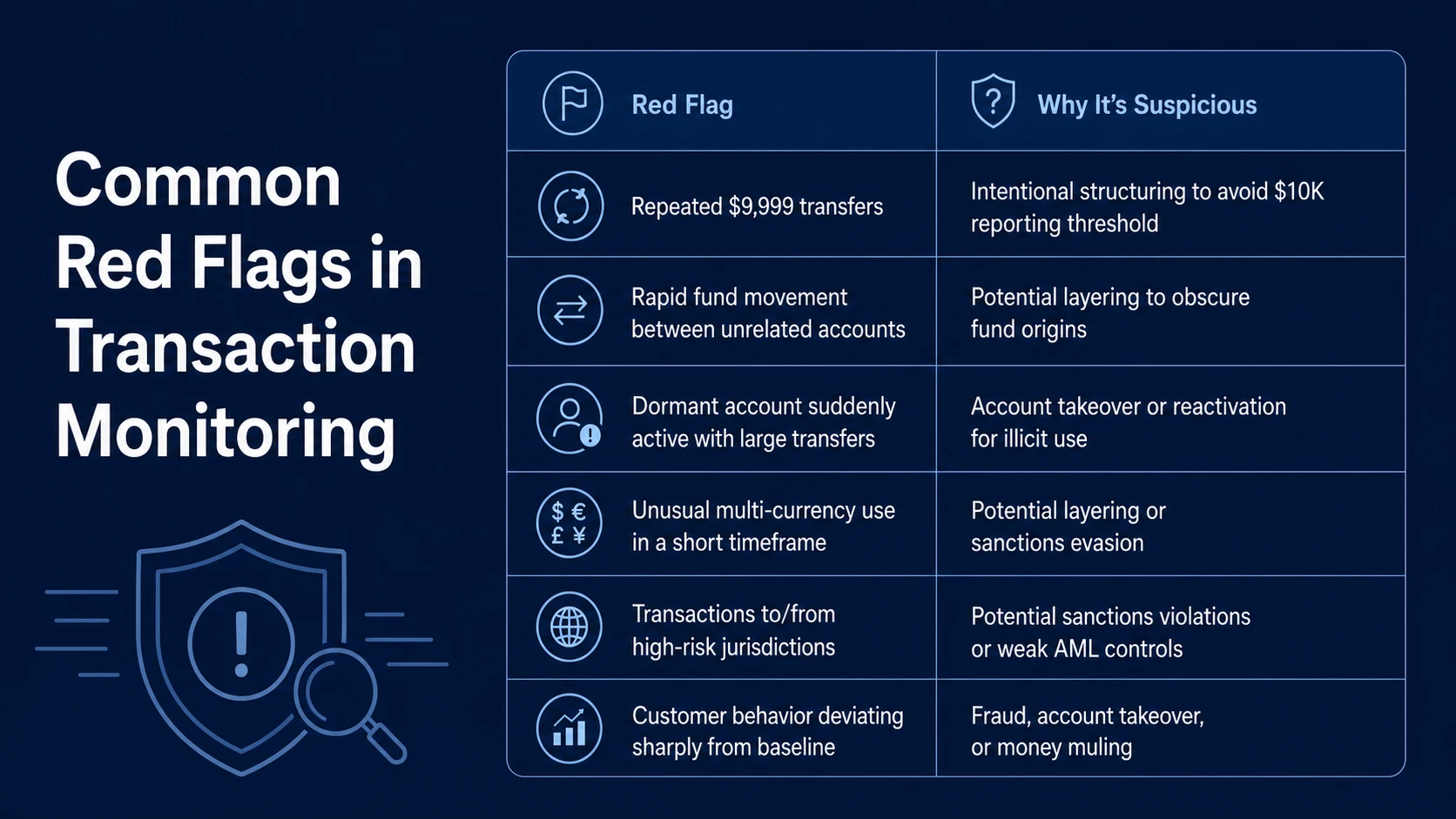
Common transaction monitoring rules and red flags
A strong transaction monitoring process usually combines several rule types.
Common transaction monitoring rules include:
Amount thresholds for unusually large payments or cash movements
Velocity rules for repeated transactions in a short window
Geographic rules for high-risk jurisdictions or sanctioned regions
Counterparty rules for PEPs, sanctioned entities, or suspicious wallets
Structuring rules for repeated transactions just below reporting thresholds
The biggest challenges in transaction monitoring
The hardest part of transaction monitoring is not usually finding risk. It is managing noise. Well-calibrated programs can keep false positive rates low, but many institutions still struggle with alert volumes so high that meaningful review becomes difficult.
Static rules are another problem. Fraud patterns change, payment behavior changes, and regulations change. A rule library that was sensible a year ago can become either too loose or too restrictive if it is not reviewed regularly.
Then there are coverage gaps. If your monitoring does not see all payment types, channels, or counterparties, you do not have a complete risk view. That matters for credit card transaction monitoring, ACH monitoring, and digital assets transaction monitoring alike.
What to look for in transaction monitoring software
If you are evaluating transaction monitoring software, start with coverage. The system should ingest the payment types and channels you actually use, not just the easiest ones.
Next, look for flexibility. Good systems allow risk-based segmentation, rule tuning, and policy changes without turning every adjustment into an engineering project.
You also need explainability. If a model or rule fires, analysts and auditors should be able to understand why. That is especially important in AI transaction monitoring, where “black box” outputs create compliance problems of their own.
Finally, do not treat case management, dashboards, and review cadence as optional extras. A useful transaction monitoring system should help you track alert volumes, false positive rates, conversion to SARs or STRs, investigation timelines, and backlog trends. Those metrics are what show whether the program is getting better—or just getting louder.
How CSG Forte helps strengthen transaction monitoring and fraud prevention
Transaction monitoring is only as strong as the controls around each payment. CSG Forte approaches this as a layered risk stack rather than a single checkpoint. Before money moves, Forte’s verification and authentication capabilities help validate account details and account ownership, which can reduce bad data, payment fraud exposure, and avoidable downstream alerts.
As activity moves through the payment lifecycle, CSG Forte PaymentsProtection.ai adds near real-time, AI-powered fraud detection across ACH and card transactions, while related Forte capabilities support ACH fraud controls, tokenization, and recovery workflows. The result is a more practical model for organizations that want stronger fraud transaction monitoring without creating unnecessary friction for legitimate payers.
Frequently asked questions
What does transaction monitoring look like in practice?
In practice, it looks like dashboards, alert queues, case files, and workflows. Analysts review flagged activity, investigate context, document decisions, and escalate the small percentage of alerts that truly merit action.
What is the difference between payment screening and transaction monitoring?
Payment screening checks a specific transaction or counterparty against sanctions, PEP, and watchlists. Transaction monitoring looks at customer behavior over time to identify suspicious patterns that screening alone would miss.
What is a transaction monitoring policy?
A transaction monitoring policy is the internal governance document that defines how an institution segments risk, applies rules, triages alerts, escalates cases, files reports, and reviews the program over time.
How often should a transaction monitoring program be reviewed?
At minimum, teams should review performance regularly and tune rules when customer behavior, products, or threats change. Quarterly review is a practical starting point for many organizations, especially where fraud patterns move quickly.
Is transaction monitoring required by law?
For institutions subject to AML and related financial crime rules, yes. Regulators expect ongoing, risk-based monitoring capable of identifying and reporting suspicious activity—not just a one-time onboarding check.
Transaction monitoring is no longer a niche compliance function. It is an operational necessity for any organization moving money at scale. The institutions that do it well are not the ones with the most alerts. They are the ones with the clearest data, the most disciplined tuning, and the best balance between risk control, compliance, and customer experience.